
KRINAVI TRIP FIT
KRINAVI Trip Fit
75/100Taejongdae’s appeal is the walk through Yeongdo forest to wave-cut cliffs, an observatory and lighthouse. The Danubi Train can save energy on the 4.3-kilometre ring road, but the lower platforms still involve stairs. The park is free; the adult circuit fare was listed as KRW 4,000 in the city information checked for this page.
- Time efficiency65/100
- Route fit75/100
- Planning flexibility85/100
- Weather resilience75/100
- Crowd control60/100
- Value for cost90/100
At the southeastern end of Yeongdo, forest meets an exposed rocky shore. Erosion has formed the steep cliffs and visible rock layers. Taejongdae became Korea Scenic Site No. 17 in 2005 and part of the Busan National Geopark in 2013.
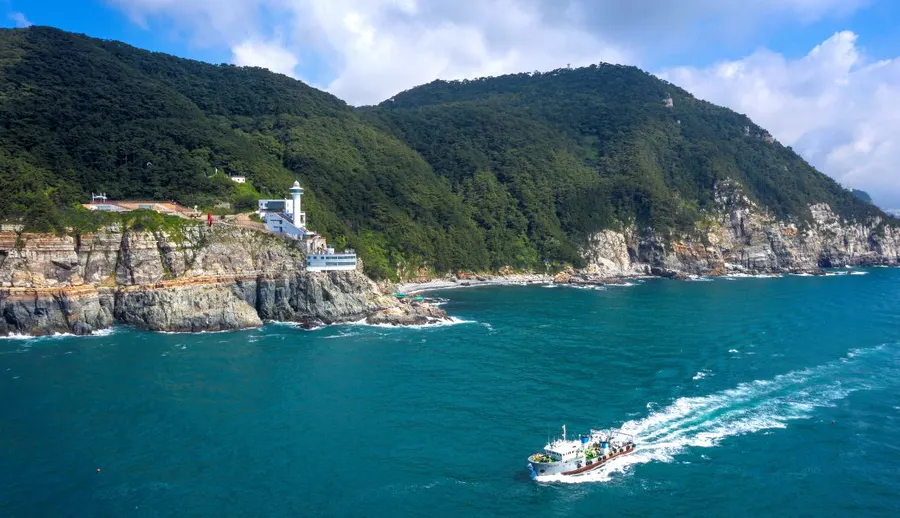
- COAST: look at the rock layers, forest and open water together; the value is more than a sea photograph.
- TRAIN: Danubi cuts some of the 4.3-kilometre walk but depends on current service hours, Monday closure, weather and queues.
- STAIRS: a train stop does not reach the lower shore. The lighthouse platforms require a descent and climb back.
- Best for travellers comfortable with slopes who can leave at least two hours for the park.
What is Taejongdae? It is not a single sea-view observatory
A local story associates the name with Silla’s King Taejong Muyeol and archery practice. Treat it as oral tradition. The geological visit is the meeting of forest, cliff and open sea.
The Busan city FAQ lists recreation-area access as 04:00–24:00 from March–October and 05:00–24:00 from November–February; admission has been free since 2006. These are gate hours, not operating hours for Danubi, indoor exhibits, lighthouse spaces, cafés or cruises. Related guide: three-day Busan itinerary
Admission is free, but park, train and cruise are separate
Walking the park costs no train fare; Danubi and sightseeing boats charge separately. A free entrance can still take half a day once the bus journey, queues and stairs are included.
Busan City currently lists KRW 4,000 for the adult circuit, KRW 2,000 for youths and KRW 1,500 for children. The published fare table does not list an adult one-way ticket, so do not assume one is available. Check the city notice for any revised prices or eligibility discounts. Related guide: how many days a first Busan trip needs
Current Danubi fares and seasons: do not copy an old English price
Danubi is regularly closed on Mondays and may stop in poor weather. Busan City lists operation from 09:20 to 19:30 in June–August, 09:20 to 18:30 in September–October and 09:20 to 17:30 in other months; ticket sales begin at 09:00. A downhill-only service may run after the sightseeing loop ends. Check the current notice for the exact date and ticket status.
The ring road is about 4.3 km. Walking allows a slower forest-and-coast visit and can take 2.5–3 hours with stops. Danubi reduces some walking and lets passengers get off for later services, but queues and vehicle capacity can lengthen waits.
Is Danubi worth it? You are buying uphill energy, not zero walking
The train helps first-time visitors, groups managing heat or fatigue, or travellers who want to reach two main stops. Strong walkers may not need it. It is not useful on a Monday closure, before service begins or if you stay aboard without visiting a stop. A transit card does not include the Danubi fare.
A 90-minute visit depends on a smooth Danubi run and one stop. Two to 2.5 hours can cover the observatory and lighthouse with waits and stairs. Allow three hours or more for the full loop, Taejongsa, lower viewpoints or a confirmed cruise. Related guide: Busan transport card

Allow 90 minutes, two hours or three hours?
Choose one main stop and one optional extension. If the train queue is long, shorten the route rather than trying to collect every viewpoint.
The observatory is the easier ring-road stop. On exceptionally clear days, official information says Oryukdo and sometimes Tsushima may be visible; neither view is assured. Yeongdo Lighthouse offers closer cliff perspectives but requires more stairs.
Observatory or Yeongdo Lighthouse: which is better?
Start with the observatory if energy is limited. Choose the lighthouse when the group wants its architecture and lower cliff views, but plan for the climb back to the train stop.
The descent to the lower platforms feels easier than the return. Wet surfaces, summer heat and winter wind increase the effort. Wear grippy shoes, bring water and confirm everyone is comfortable before descending.
The real cost of the lighthouse stairs is the return
Sinseon Rock and the lower platforms sit beside cliffs and active waves. Stay behind barriers and away from closed areas, particularly in strong wind.
Fog can erase the long view; heavy rain makes steps and rock slippery, while wind can make the decks uncomfortable. Danubi may also suspend in bad weather, so it is not a reliable rainy-day shelter.
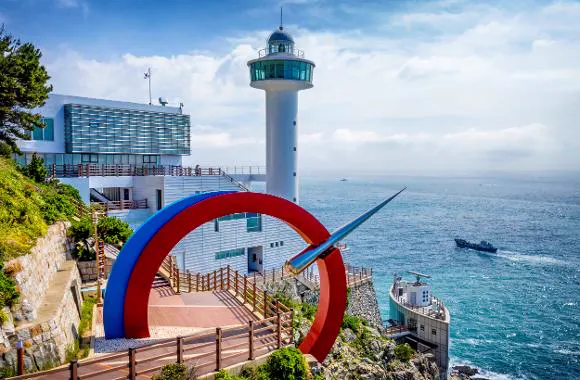
Rain, fog and strong wind: Danubi is not an all-weather guarantee
Use the linked rainy-day guide for indoor alternatives. If the train is stopped, take only a short entrance-area walk when conditions and mobility allow, or reschedule.
The city FAQ identifies the lighthouse and observatory as sunrise viewing points without separate admission. Sunrise access is a walking plan before Danubi service; check darkness, lighting, closures and weather on the date. Related guide: Busan rainy-day plan
Sunrise is possible, but Danubi will not carry you back
Gate opening does not guarantee comfortable solo access to cliff paths before dawn, and park access until midnight does not mean every stairway is lit or staffed.
Visit Busan lists accessible parking and toilets, guide-dog access, free wheelchair rental at the main-gate information centre and a wheelchair lift on Danubi. These help with the ring road and principal stops, not every stair or rocky path.
Wheelchairs, older visitors and families: support does not cover every step
For a child or older companion, Danubi and the main observatory can make a complete visit. Add the lighthouse only after checking the return climb, weather and energy; confirm wheelchair stock and lift service directly.
Taejongsa hydrangeas and festivals vary by year. Check same-year bloom and event notices instead of reusing an old June or July schedule. Related guide: three-day Busan family itinerary
Hydrangeas and the Secret Forest are not automatic extras
Visit Busan describes the Secret Forest route as about 3.5 km with narrow, steep and rocky sections; it may close seasonally for fire prevention. Treat it as a separate hike and use it only when an official notice confirms access.
The city FAQ lists adult coastal cruises at KRW 15,000 and children 12 or younger at KRW 8,000, with operation weather-dependent. Confirm the specific pier and operator; schedules are not shared across all boats.
Is a sightseeing cruise worth adding?
A cruise adds a pier transfer, wait and return climb. Consider it only after the land route, especially when motion sickness, waves or a two-hour limit matters.
Taejongdae centres on forest, cliffs and lighthouse stairs; Oryukdo is a shorter headland stop; Songdo pairs beach facilities with a paid aerial crossing.
Taejongdae, Oryukdo or Songdo: choose the type of coast
Choose Taejongdae for geology and walking, Oryukdo for a brief headland visit or Songdo for an elevated view. Doing all three in a day replaces coast time with cross-city transfers.
Taejongdae has no subway station. Common buses from Nampo include 8, 17, 30, 88 and 186; from Busan Station, 17, 88 and 101 are commonly listed. Verify current routes and stops, and save 태종대 as the map destination. Related guide: Busan one-night versus two-night decision
Connect Yeongdo and Nampo instead of making an isolated return trip
Pair the park with Nampo, Yeongdo or the southwest. A four-day trip can dedicate a day to the west and southwest; with five days, reserve flexibility for fog or strong wind.
Allow two to three hours for the forest, geology, viewpoints, stairs and return. Use Danubi to reduce walking while still visiting stops. Postpone the visit if travel time or daylight leaves the route rushed. Related guide: four-day Busan itinerary · five-day Busan itinerary
Eleven checks before you leave
- Is the aim the coastal landscape or simply riding the train?
- Check current seasonal service for the visit month.
- Could a Monday closure or bad weather stop Danubi?
- Can ticket sales close early when capacity fills?
- Choose between the easier observatory and the stair-intensive lighthouse.
- Will everyone be comfortable climbing back from the lower platforms?
- Check whether fog, wind or rain will obscure the coast or make the surface unsafe.
- For wheelchair users, older visitors or families, is the ring-road version enough?
- Verify same-year hydrangea, sunrise, cruise and Secret Forest conditions separately.
- Leave time for the return bus and any next stop.
- If the train is stopped, is a shorter walk or another day acceptable?
Checked 23 August 2026. Busan city information was used for gate hours, free admission, current fares and operating limits; Busan National Geopark for the geological and historical context; Visit Busan for route, accessibility and park details. Recheck service, blooms, trails, cruises, construction and night lighting before travel.
Checked October 26, 2026. Busan City’s park FAQ supplies gate hours, admission, current Danubi fares, seasonal service, Monday closure and weather-related limits. The English Geopark page is retained for location and geology; its train fares and hours differ from the newer Korean city notice. Busan National Geopark supplied the geological and historical context. Visit Busan supplied the address, buses, observatory, lighthouse, accessibility services and images. Recheck train, observatory, lighthouse, cruises, Secret Forest, flowers, construction and night lighting on the visit date.
Busan City | Park FAQ Busan National Geopark | Taejongdae Visit Busan | Taejongdae Park
KriNavi decision card
Sources checked in this page: Source 1 · Source 2 · Source 3