
KRINAVI TRIP FIT
KRINAVI Trip Fit
70/100Choose a Busan base by the direction of your days and where evenings end. Seomyeon keeps several districts reachable; Haeundae and Gwangalli suit repeated coast time; Nampo puts markets, the port and Yeongdo closer together.
- Time efficiency65/100
- Route fit85/100
- Planning flexibility65/100
- Weather resilience65/100
- Crowd control65/100
- Value for cost65/100
For two or three nights with plans on both sides, Seomyeon can avoid daily hotel moves. Choose a coast-side base when evenings and the next morning are also by the water; choose Nampo for a west-side itinerary.
Write down the main fixed plans and where each day ends. If destinations point in different directions, a central base may help; if they cluster on one side, staying there avoids a return ride.
A city-focused trip uses the hotel mainly as a transfer point. A coast-focused trip may use it for a midday break and evening walk. Decide which pattern describes your actual days.
First, decide: is this a city trip or a seaside trip?
Count the days that end in different districts, not the number of attractions in each area. Seomyeon is useful when the route changes direction; a base on the same side as repeated plans can remove daily backtracking.
| What your trip centers on | Area to check first | What you gain | What you give up |
|---|---|---|---|
| First visit, want to see both east and west | Seomyeon | Movement in different directions is more balanced; eating out at night is easy | No sea view; the area itself feels more like a city commercial district |
| Markets, the port, and old neighborhoods | Nampo-dong | West-side plans can stretch from morning into the night | Longer round trips for east-coast days |
| Beaches, families, and eastern Busan | Haeundae | The sea is not a day trip, but the backdrop to everyday life | Old-town and west-side plans are no longer on the way |
| Evening sea views, cafés, and a slower pace | Gwangalli | You don’t have to rush away from the coast at night; the stay has the clearest atmosphere | Not suitable if you need to race across both ends of the city every day |
Seomyeon’s trade-off is that the evening remains in a commercial centre rather than beside the beach. If several nights end by the coast, the middle location can feel like an extra ride.
The four areas are really four very different kinds of nights
Seomyeon: when your plans aren’t fixed yet, or your group often splits up
Nampo connects markets, port streets and old downtown within a compact west-side day. It is not a shortcut to the east coast, so repeated Haeundae plans still require cross-city travel.
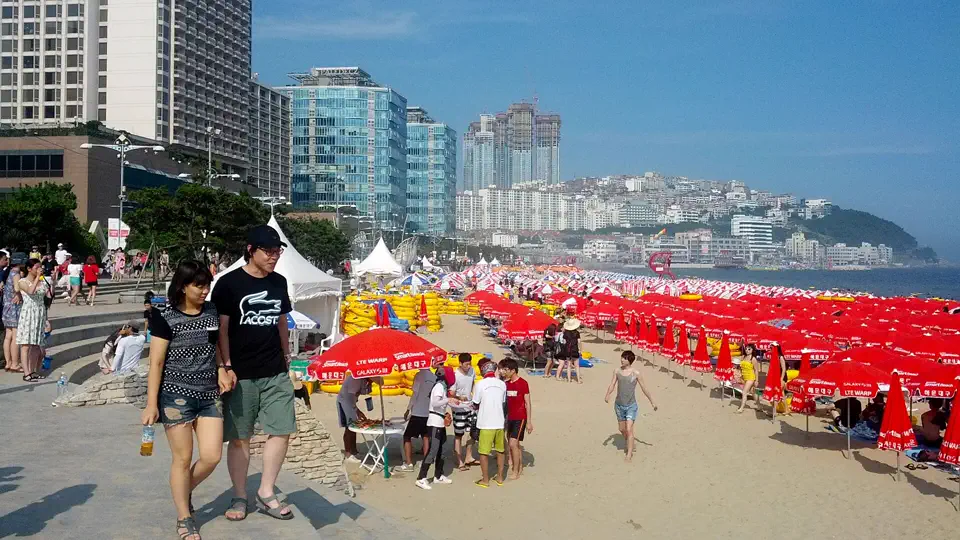
Haeundae can connect a morning beach visit, room break, dinner and a walk back. That benefit matters when the coast repeats; a single daytime photo stop may not justify a longer trip to the rest of Busan.
Nampo-dong: tying food, shopping, and old-town walks into one route
Check the exact Haeundae hotel address against transport, entrance and luggage route. A neighbourhood label or sea view does not confirm a convenient arrival.
Gwangalli suits travellers who want to keep an evening open for dinner and the waterfront. It trades broad transport reach for a coast-side rhythm.
Haeundae: trade cross-city time for living by the sea every day
If every day runs early-to-late and the room is only for sleep, a sea view may be unused. For older travellers, children or heavy bags, verify the actual route to transit.
Once the choice is down to Haeundae or Gwangalli, compare when the group will use the shore: morning, daytime or after dinner.
Gwangalli: when your itinerary doesn’t need to be packed, the beach becomes more than a backdrop
Two or three nights rarely leave spare time for moving hotels. On a longer trip with full blocks on both sides, a split can make sense if the second address removes repeated cross-city trips.
Arrival and departure are partial days. Include immigration or train arrival, luggage and the final airport or station route without counting them as full sightseeing time.
Choose the base around the least flexible traveller’s walking, stairs, stroller or luggage needs. Check hotel approaches rather than assuming a district is accessible. Related guide: Haeundae vs Gwangalli: what time of day you’ll really use the beach
Fit the hotel into the real trip, not the ideal one
For peak dates or a major event, compare cancellation terms and the confirmed post-event route. A venue address alone does not mean the whole trip belongs beside it. Related guide: Busan single-base vs split-stay moving-cost test
For a first four-day visit with plans across the city, start by checking whether Seomyeon’s route flexibility fits. If most activities cluster east, compare Haeundae instead.
For a family coast holiday, Haeundae can support repeated room breaks and nearby evenings. Budget more transfer time for old-town days.
For markets, food and port streets, Nampo can keep the day connected by walking and short rides. A coast-side hotel move should match a real change in itinerary. Related guide: Korea season and event planning
Three common trip styles, and where they point you to stay
For a Seoul–Busan trip, treat the KTX day as a transfer day. Check luggage and the first hotel route separately from the rest of the Busan plan.
Mark the fixed activity each day, the first stop and the place you expect to be after dinner. Compare the hardest day from each base, not an average travel-time estimate.
After choosing one or two areas, compare the same dates, guest count, room and cancellation terms. Reject options whose final walk or luggage space does not fit.
Use the linked city guide to check the overall route and the Korea itinerary to confirm city order. Choose a Busan base for the nights you have, not someone else’s hotel list. Related guide: how to split a Seoul itinerary by district · the first-night decision after taking KTX from Seoul to Busan · the Seoul-to-Busan eSIM handoff checklist · the Seoul accommodation area comparison
When choosing tonight’s area, make only one route map that actually matters
With one or two areas selected, compare exact properties and the route back at night. A good district choice can still be undone by a difficult hotel entrance.
If daily destinations change direction, compare Seomyeon’s actual transfer and return routes. If the coast should be part of daily life, check the Haeundae room-break and evening pattern.
For a west-side stay, assess whether Nampo keeps markets, port streets and dinner connected. For a slower waterfront evening, decide whether Gwangalli merits the extra time. Related guide: the Busan independent travel guide · the guide overview · the Seoul hotel room-selection decision guide
When one or two districts remain, use Busan hotel comparison: putting one night into real movement to compare the same dates, room type, cancellation terms and final walk to the hotel. It checks the last-mile fit after you have chosen the right area.
When your plans move between districts each day, how Seomyeon stays flexible when your itinerary shifts looks at Seomyeon through the transfers and returns to your room that shape that flexibility.
A Haeundae room makes most sense when you plan to use the area during the day. which trips Haeundae accommodation should be saved for weighs afternoon breaks, dinner and the return to your room alongside the sea view.
For a day built around markets, the port and dinner, how Nampo-dong accommodation preserves the old-town pace considers Nampo-dong as a west-side base without adding an east-coast detour.
If the choice has narrowed to city bases in Seomyeon or Nampo-dong, Seomyeon vs Nampo-dong: how many directions you’ll actually move in over four days compares four-day movement: daily flexibility against keeping west-side trips close to your stay.
For an evening by the water, whether Gwangalli is worth slowing the trip down for the night view asks whether staying in Gwangalli gives you enough time for the night view without rushing back to transport.
When Seomyeon and Haeundae are the finalists, how Seomyeon and Haeundae are decided by the final stop focuses on the last stop and return route that can decide between them.
For a three-day stay, how to split Busan’s west and east sides into full days over three days sets the west/east split. Check where each day ends to see which base reduces the return journey.