
KRINAVI TRIP FIT
KRINAVI Trip Fit
65/100Trip Fit for this Seopjikoji visit is 65/100. The cape is an outdoor walk, not a roadside lighthouse stop: allow 60–120 minutes and choose the route by wind, footing, mobility and how much of East Jeju you plan to cover.
- Time efficiency55/100
- Route fit75/100
- Planning flexibility60/100
- Weather resilience60/100
- Crowd control75/100
- Value for cost75/100
The current Trip Fit dimensions remain in the score panel. Check the latest access and operating notices before planning around it.
Seopjikoji is an exposed cape with grassland, volcanic rock, coastal views and a white lighthouse. Set aside 60–120 minutes depending on whether the group walks only the lower coast or adds the stairs.
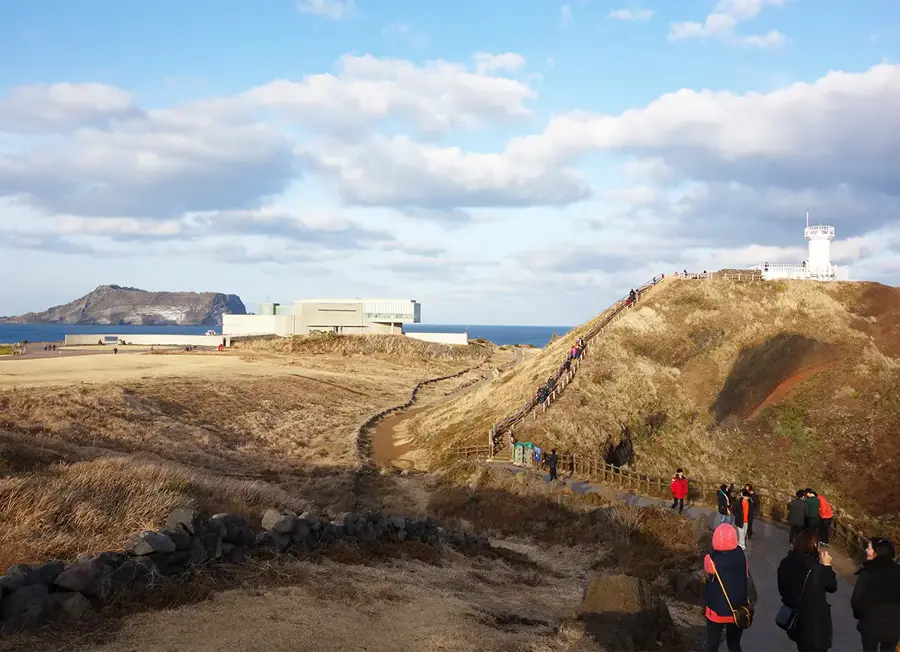
- WIND: check gusts, rain, sun and daylight for an exposed cape.
- WALK: the free public route includes slopes and optional lighthouse stairs.
- ROUTE: pair the cape with Seongsan or another East Jeju stop.
- First visit: arrive in daylight, walk the lower coast and add the stairs only if conditions and mobility allow.
The cape is more than its lighthouse
Seopjikoji projects from Seongsan-eup into the eastern sea. Jeju’s “koji” means a cape or headland; official pages give more than one explanation for “Seopji.” Grassland, volcanic coast, the signal station, Seondolbawi, Bulgeunoreum and the lighthouse make up the visit.
The cape and Seongsan Ilchulbong appear together in many photos, but are separate stops. Seopjikoji is mainly a coastal walk; Seongsan adds a separate paid summit climb. On a three-day trip, give Seopjikoji a set window within the east-coast day: three-day Jeju itinerary
Read the volcanic ground and shoreline
Visit Jeju describes reddish volcanic material, called songi locally, around Bulgeunoreum. The slopes show scoria and other volcanic features; low tide can expose more rock along the shore.
Seondolbawi is interpreted as the remnant of a volcanic feeder dyke. Local legend offers a separate story about the rock. Keep those accounts distinct, and view the coast from established paths; low tide does not make wet or restricted rocks safe to cross.
Use daylight for the first visit
Visit Jeju lists the public outdoor cape as free and open year-round. That does not mean every path is lit or staffed at night. Treat a dark arrival as a separate safety and transport decision.
For a first visit, daylight makes the route and footing easier to assess. Before dawn or after dark, check the road, public parking, lighting, wind and return plan; do not follow an unlit cliff or lighthouse branch just because the cape has no gate.
Separate public entry from paid facilities
The public cape has no admission fee. Visit Jeju lists the public car park at KRW 1,000 for the first 30 minutes, then KRW 500 per additional 15 minutes, capped at KRW 3,000 per day. Phoenix Island parking is separately listed at KRW 5,000 per day. Confirm the signs and current charges on arrival.
The public coast, Phoenix Island, Glass House and museum complex share a broad area but can have different entrances, parking and admission. Choose the public car park for the free coastal walk; do not assume nearby facilities share its terms.
Navigate to the public car park
Official pages show different Seopjikoji-ro numbers, including 262 and 107. Search for the named public car park in Korean map apps and check the current entrance marker rather than relying on an address copied from another attraction.
In Korean navigation, use “섭지코지 주차장.” Check the approach and public parking sign before turning in; the first Phoenix Island sign may lead to a different car park and fee.
Choose a 60, 90 or 120-minute walk
For about 60 minutes, walk from the public car park along the lower grassland and coast, choose one view of Seondolbawi or Seongsan, then return. At 90 minutes, consider the lighthouse stairs only if footing, wind and energy are suitable.
Allow up to two hours for a slower pace, photographs, children or the exterior architecture. A Glass House visit or museum time is separate. A four-day itinerary gives more room: four-day Jeju itinerary
The lower route and lighthouse stairs differ
The lower route has broad paths and grassland, but the full cape includes slopes, walls, stairs and exposed sections. Visit Jeju marks assistance difficulty as “Difficult”; a flat entrance view does not describe the whole route.
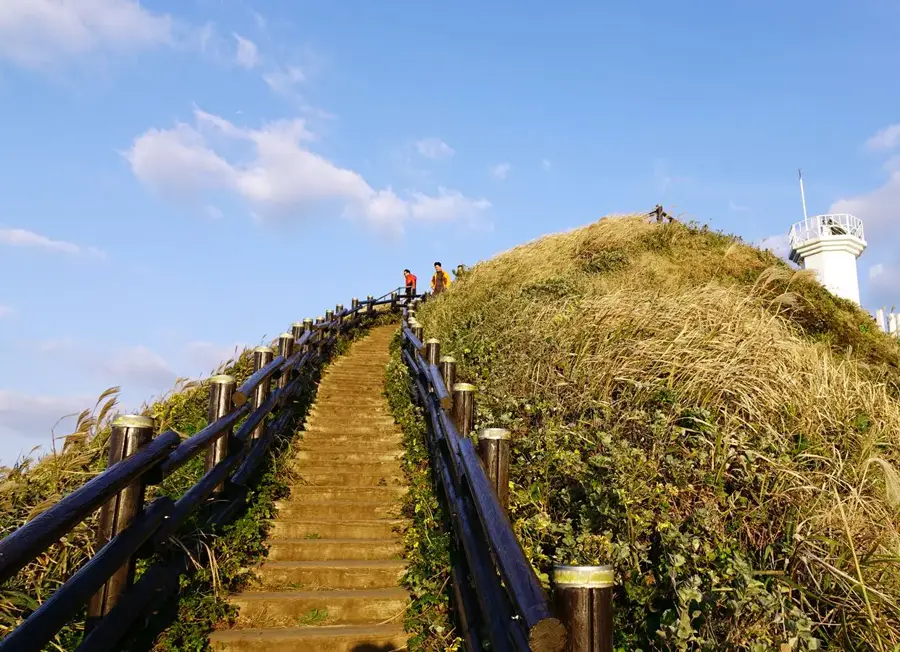
The lighthouse viewpoint involves climbing and descending stairs. Anyone avoiding stairs can finish the lower coast and turn back; reaching the lighthouse is not required for a complete visit. Wear shoes with grip and keep stair landings clear.
Confirm step-free access before travelling
Some lower paths may be usable without stairs, but there is no confirmed step-free circuit to the lighthouse. Works, crowds, parking location and wet surfaces can change the endpoint. If access is essential, call +82-64-784-2810 and ask which viewpoint is reachable from which car park on your date.
Do not take a large stroller onto crowded stairs unless the adults can control it safely. The group can meet at the lower route while others climb briefly. The coast, grassland and Seondolbawi remain visible without the lighthouse branch.
Check wind as well as rain
The cape has little shelter. Check sustained wind, gusts, feels-like temperature, lightning and coastal warnings, not rain percentage alone. Wind affects balance on the stairs as well as hats, umbrellas and strollers; follow barriers and staff directions.
In strong wind or rain, leave the exposed edge and use a confirmed indoor option: Jeju rainy-day plan Wet stairs, mud and poor visibility still matter after a shower.
Choose a time that leaves a safe return
Morning can bring softer light and fewer cars, but a pre-sunrise visit adds darkness and wind. Midday has little shade and more summer heat. Afternoon light may be warmer; preserve daylight for the return.
Weekends, holidays and spring bloom can concentrate visitors on the lighthouse stairs. Choose a few viewpoints, keep moving with the path and leave room for others instead of repeatedly backing up for a clear photograph.
Spring flowers are seasonal, not guaranteed
Spring can bring canola flowers, but bloom depends on weather, planting and land management. An official spring description does not guarantee flowers during a particular week or permission to enter planted areas.
Stay on paths and follow signs around fields. Outside peak bloom, volcanic slopes, the coast and Seondolbawi still define the visit; if flowers are the main reason to go, keep the timing flexible.
Autumn and winter change the walking conditions
Autumn grasses and winter views show the cape in a different light. Shorter days, stronger wind and damp stairs can make the route more demanding than the temperature in Jeju City suggests.
Wear a wind-resistant layer and grippy shoes; secure loose hats and scarves. In winter, start early enough to finish in daylight. If the group is uncomfortable at the entrance, take one lower view and leave.
View horses and shore from marked paths
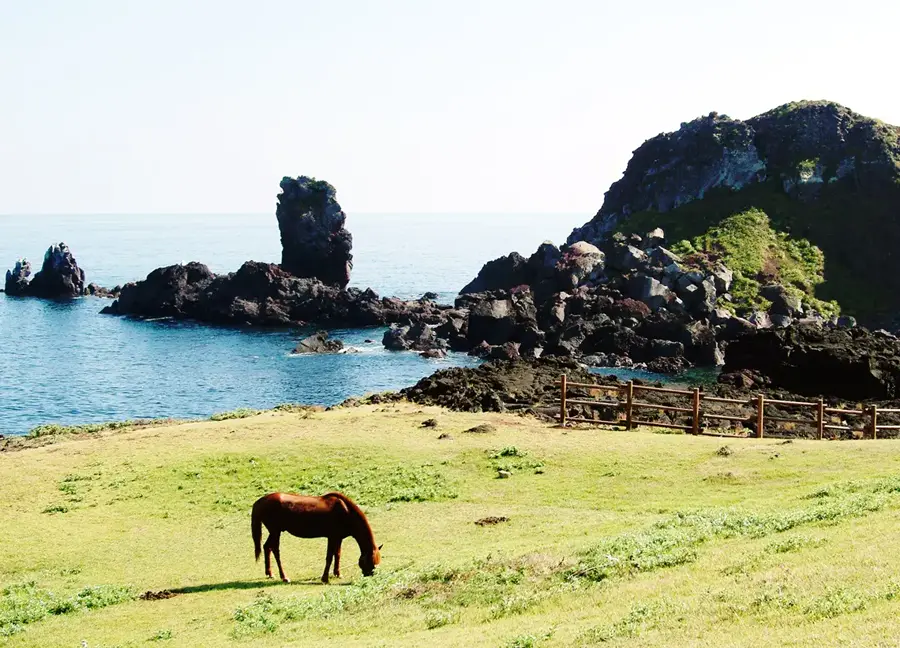
The cape combines Seondolbawi, black volcanic rock, grassland and grazing horses. Do not feed, chase or approach the horses from behind. Low tide may reveal more rock, but does not create a safe route across it.
Use marked viewpoints and keep animals and coastline within their established areas. Waves, algae and tide change the rock surface; another person beyond a barrier is not proof that access is safe.
The signal station has a history of its own
Hyeopja Yeondae is a Joseon-era coastal signal station that used fire and smoke for emergency messages. Visit Jeju describes it as about four metres high and nine metres on each side, and lists it as a provincial monument.
Its open headland position explains the signal station’s role. View the structure with the sea and horizon; do not climb it or move stones for a photograph.
The lighthouse interior is not part of the route
“Climbing the lighthouse” usually means reaching the exterior viewpoint on Bulgeunoreum. Do not assume the tower interior is open; follow current signs and barriers and keep the landing clear.
If the stairs are wet, wind is strong or the branch is closed, the lower viewpoint still shows the white lighthouse against the slope. The cape is more than its highest point.
Check nearby architecture separately
Glass House and the museum complex are separately operated. Check each facility’s opening, reservation and admission rules; public access to the cape does not include their interiors.
If architecture is your main reason for visiting, check the facility’s own current page before travelling. For a coastal walk, the public route is enough.
Arrive and park without backtracking
A car can help time the visit from Seongsan or Pyoseon, but reaches only the parking area. Confirm the public car park and driver arrangements before setting out: whether to rent a car in Jeju
Do not stop on the narrow approach road to unload. During bloom and on weekends, allow time to enter and leave; a daily fee cap does not guarantee a space or apply to the separate Phoenix Island lot.
The bus journey includes a long last mile
One Visit Jeju example uses bus 201 from Seogwipo Bus Terminal to the Sinyang-ri entrance stop, followed by about a 50-minute walk; the full journey is around two and a half hours. Treat this as one route example, not island-wide guidance.
On your date, check the Jeju bus guide for the route, stop, last-mile walk and return: Jeju bus travel guide A taxi from Seongsan may be more practical than a long bus approach. Save the return before walking to the cape.
Set a family route and meeting point
Children can look for horses, rock formations and the signal station, but set clear boundaries: stay behind barriers, do not chase animals and keep away from cliff edges. Carry water and take rubbish with you.
Visitors who avoid heights can use the lower coastal route. Add rest time rather than pushing for the top; choose a meeting point before the group separates.
Pair Seopjikoji with one main climb
Seongsan and Seopjikoji work in one east-coast day, but both include optional uphill effort. If the group climbs Seongsan, keep Seopjikoji to the lower coast or move the lighthouse stairs to another day.
Two nights around Seongsan make an early start and a weather change easier. Use the two-day east Jeju stay guide to compare the base: whether to stay in Seongsan for two East Jeju days A one-night Jeju City stay is usually too short for Seongsan summit, Seopjikoji, Udo and an evening market together.
Set the outdoor route around Aqua Planet
Aqua Planet can pair with the cape because both are in the east. Walk outdoors during a calmer, drier window and check the aquarium’s separate hours, tickets and last entry.
Choose which paid attraction anchors the half-day, then cap the outdoor walk: Aqua Planet versus Snoopy Garden for an East Jeju half day Map proximity does not guarantee enough daylight or energy for the complete lighthouse route after a long aquarium visit.
Keep east and west Jeju on separate days
Seopjikoji is on Jeju’s eastern edge. Aewol, Hallim, Hyeopjae, Sanbangsan and Jungmun are not nearby just because they share the island; a west-coast sunset can consume the useful daylight in driving.
Use the East-versus-West guide to group the day by region: East versus West Jeju Keep Seopjikoji with Seongsan, Pyoseon or another eastern stop instead of adding it as a free cross-island bonus.
A 15-point departure checklist
- Do you want a coastal walk or only a lighthouse view?
- What are the current wind, rain, lightning and feels-like conditions?
- Will the chosen route finish before dark?
- Does navigation point to “섭지코지 주차장,” the public lot?
- Have you checked whether the public or Phoenix Island lot applies?
- Have you included parking or transport despite free admission?
- Is 60, 90 or 120 minutes realistic for the group?
- Can everyone manage the slope and optional stairs?
- If step-free access matters, has the endpoint been confirmed for this date?
- Are the last-mile walk and return bus saved?
- Do you have a wind layer, grippy shoes and water?
- Will the group stay on paths and leave horses undisturbed?
- Have you checked separate hours and fees for buildings or museums?
- Is Seongsan or Aqua Planet the main attraction today?
- Is an indoor option ready for severe wind or rain?
Give the cape 60–120 minutes when you want the coast, volcanic landscape and Seongsan view. Use a shorter lower route from an east-coast base. Skip it on a short west-side trip when severe weather or access needs make the exposed walk unsuitable.
Sources and date-sensitive details
Visit Jeju’s current page supports the geology, signal station, assistance difficulty and listed public/Phoenix parking rates. Official pages show both 262 and 107 Seopjikoji-ro. Confirm the named public car park, current charges, bus service, flower conditions and step-free endpoint for your date.
Official Seopjikoji information: Visit Jeju | Seopjikoji | Seopjikoji East Jeju route and bus example: Visit Jeju | East-coast route and bus example
Seopjikoji decision card
The linked sources cover the cape, public access and one East Jeju transport example. Recheck charges, buses, weather and step-free access for your travel date: Source 1 Source 2 Source 3