
KRINAVI TRIP FIT
KRINAVI Trip Fit
75/100For four guests, compare where everyone sleeps and how the room works after the suitcases are open.
- Time efficiency70/100
- Route fit80/100
- Planning flexibility70/100
- Weather resilience70/100
- Crowd control70/100
- Value for cost80/100
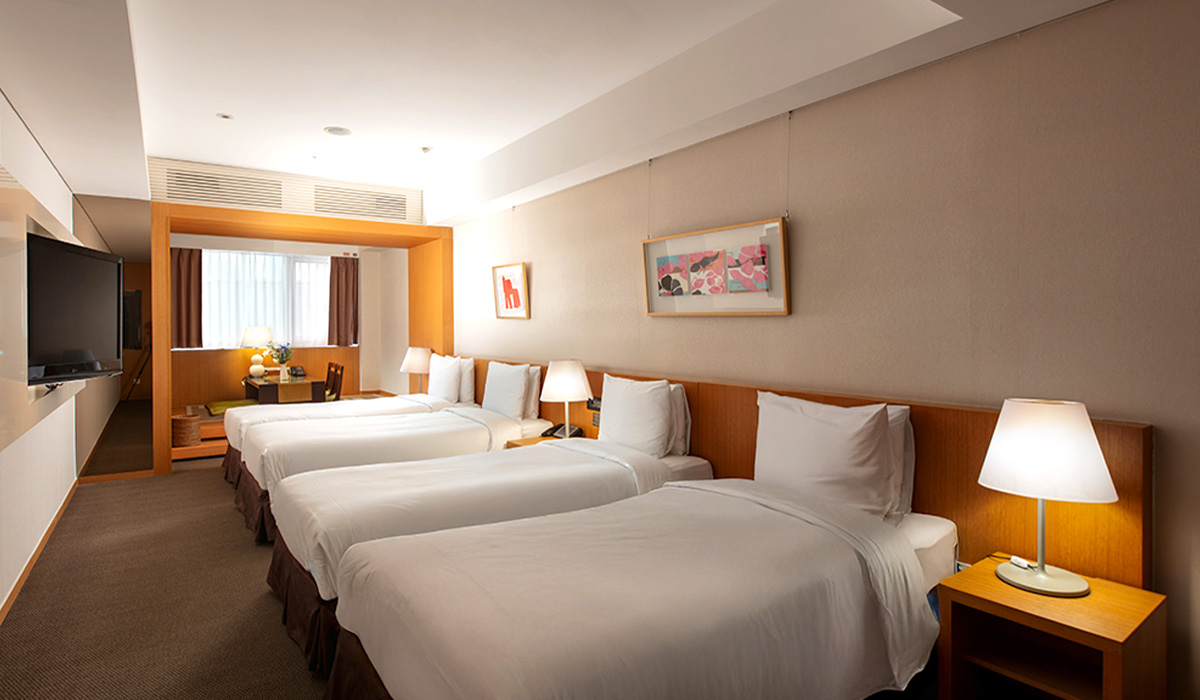
When choosing a family room for four, confirm the bed plan, child ages, occupancy, bathroom flow and any need for separation. Four singles give each guest a bed but keep everyone in one room; two doubles suit families already comfortable sharing. Bunks need an age and safety check, while a Residence costs more for additional living space. For the exact four-person room comparison, see two-kids, two-routines decision.
Start with four actual sleeping places
| Room layout | Works best when | Check before booking |
|---|---|---|
| Four single beds | Each child sleeps separately and the family shares one room | The beds are all in one space; they do not separate different bedtimes |
| Two double or queen beds | Your family already shares as two pairs | Confirm bed size and age/occupancy terms; capacity does not guarantee comfortable sharing |
| Quad bunk or bunk beds | Children want separate beds and open floor space matters | Check upper-bunk suitability and exact room availability for the children’s ages |
| Double bed plus bunk and living area | Different bedtimes, naps or longer daytime room use | Compare the higher rate and district against the living space you will use |
| Two rooms | Separate sleep or parallel bathroom use matters | Confirm room placement, keys and whether connecting rooms are actually available |
The table compares room layouts, not hotels. A booking search that accepts four guests confirms only that a product is being offered to that party; it does not say whether the beds, bathroom or open floor will work for your group.
Choose the room count before comparing products. If two rooms remain an option, use one family room or two rooms in Seoul to weigh bedtime, bathrooms and key management against one shared room.
Four singles: clear bed assignments, one shared room
Hotel PJ lists its Premier Quad at 56 m², with four 100×200 cm single beds and capacity for four. That is a clear bed plan: no one needs to rely on a sofa bed or decide which pair shares.
Four beds do not create a separate sleeping zone. If one child turns in early, the rest of the family still shares the same room and light/noise. The two-children guide Seoul hotel guide for two children covers that separate routine problem.
If three guests fit the listed beds, check the location and evening route in Hotel PJ Myeongdong decision page. For four people, compare the exact bed layouts before choosing the room.
Two double beds: confirm the family accepts sharing
Two double or queen beds keep the sleeping footprint compact. The official Four Points room page lists products for up to four guests, and Moxy’s gallery includes Double/Double and Family Queen Queen images; verify the exact room and occupancy for your dates.
Two larger beds work when the family already shares as two pairs. A booking page’s four-person setting does not establish that children can share comfortably or that the exact bed size matches your expectations.
For Euljiro access, compare the exact Four Points room; for repeated Myeongdong evenings, look at Moxy. The property pages are Four Points Josun Myeongdong and Moxy Seoul Myeongdong. Let the location and selected room pass separately.
Compare products within the same hotel
Moxy provides different examples under one hotel name: Family Queen Queen, Quad Bunk and Double/Double. These are not interchangeable room layouts; compare the exact product label with its bed and occupancy terms before booking.
A bunk can give older children separate beds and leave more central floor free. The upper bunk may not suit every age or nighttime routine. Confirm the exact product and any current restrictions with the hotel; do not infer suitability from a photo.
A stroller adds another route test: the lift exit, street crossing and final walk to the entrance. Use the stroller hotel test: elevator exit and the last 500 metres after the bed plan works.
A Residence adds room separation and facilities
Novotel lists a Residence Premier Family 1 Bedroom with one double bed and one bunk bed. Its official page gives 80.9 m² and describes a separate living area, kitchenette, washing machine and workspace.
The additional space is useful for naps, an early bedtime or a longer stay that uses laundry and the kitchenette. Check the Dongdaemun route before paying more; if the location fits, read Novotel Ambassador Seoul Dongdaemun review.
Bunks are a room layout, not proof of child suitability. Verify the selected room’s age, safety and occupancy terms for the actual party before paying.
Check age and occupancy against the exact room
A six-year-old and an eight-year-old may be comfortable with bunks or separate singles; a toddler may need a crib and adult proximity. Enter the children’s exact ages and consult the Seoul hotel guide for babies and toddlers when nap or feeding needs shape the room.
Search with the real guest ages. Occupancy, crib and extra-bed conditions vary by hotel, product and booking channel; compare the exact room name and date, not another family’s search result.
Test the bathroom and the busiest morning
Morning traffic can be the limiting factor. Four people sharing one bathroom may need to shower, dress and pack within the same departure window; extra floor area does not add a second bathroom.
If everyone must get ready at once, compare the family-room setup with one family room versus two rooms. Two rooms may provide another bathroom or door, but only if the family can manage room assignments and keys.
Measure usable space after beds and luggage
Floor area is useful only after the beds and luggage are placed. Four singles use more floor than two doubles, while bunks can leave a central path; compare the exact product plan rather than the hotel’s largest room photo.
Use galleries to see how a room is arranged, not to assume that the displayed product is the one in your rate. Keep the room name, bed configuration, occupancy and cancellation terms beside the photos.
Compare rate inclusions on the same terms
Compare the same room on the same dates, for the same four guests and breakfast terms. A non-refundable rate is not like-for-like if school, flights or family plans may change.
Check whether breakfast will be served at the time you leave with Seoul hotel breakfast decision; use the hotel cancellation and payment guide when dates or travellers are not fixed. Keep meal and cancellation differences out of the bed comparison.
Choose the district after the room passes
A scarce four-person room can tempt families to accept any district. Confirm beds first, then place the hotel against the repeated day routes, evening plans and departure.
For Myeongdong and central routes, compare the Hongdae/Myeongdong family base guide Hongdae vs Myeongdong with kids; for the broader room-and-area choice, return to the Seoul family-hotel decision hub. Hotel PJ, Moxy and Four Points suit different combinations of room and location.
Decide by the sleeping arrangement the family can use
If the children want their own beds, compare four singles. If they share as two pairs, two double or queen beds may use less floor. Bunks keep separate sleeping places but need an age check. A Residence adds space for naps or different bedtimes. If everyone gets ready together, compare a second room and bathroom.
Before paying, assign each guest a bed, confirm the age and occupancy rules, and check where luggage fits. Reconsider the room if any part of that plan is unresolved.
Sources and recheck
- Hotel PJ | Premier Quad: currently lists 56 m², four 100×200 cm single beds, capacity 4, check-in 15:00 and check-out 12:00. Rechecked 2026-08-20.
- Moxy Seoul, Myeongdong | Rooms: current official page references the family room and Four Quad Bunk. Rechecked 2026-08-20.
- Moxy Seoul, Myeongdong | Photo Gallery: current official gallery lists Family Queen Queen, Quad Bunk and Double Double room imagery. Gallery labels are not used here as a guarantee of availability or child occupancy for a specific date. Rechecked 2026-08-20.
- Four Points by Sheraton Josun, Seoul Myeongdong | Rooms: current official page states that hotel rooms include options accommodating up to 4 guests; exact product and child ages must still be checked for the selected dates. Rechecked 2026-08-20.
- Novotel Ambassador Seoul Dongdaemun | Residence Premier Family 1 Bedroom: current official page lists 80.9 m², 1 Double Bed & 1 Bunk Bed, kitchenette, washing machine and dedicated workspace. Rechecked 2026-08-20.
Room inventory, child occupancy, bunk rules, cribs, extra beds, breakfast, rates, cancellation and connecting-room arrangements vary by date and product. Recheck the selected hotel or booking page before payment.
KriNavi decision card
Use this guide to match four guests with a room’s actual beds and occupancy limit.
Compare the bed layout against sleep routines, bathroom use and luggage space.
Sources checked in this page: Source 1 · Source 2 · Source 3 · Source 4